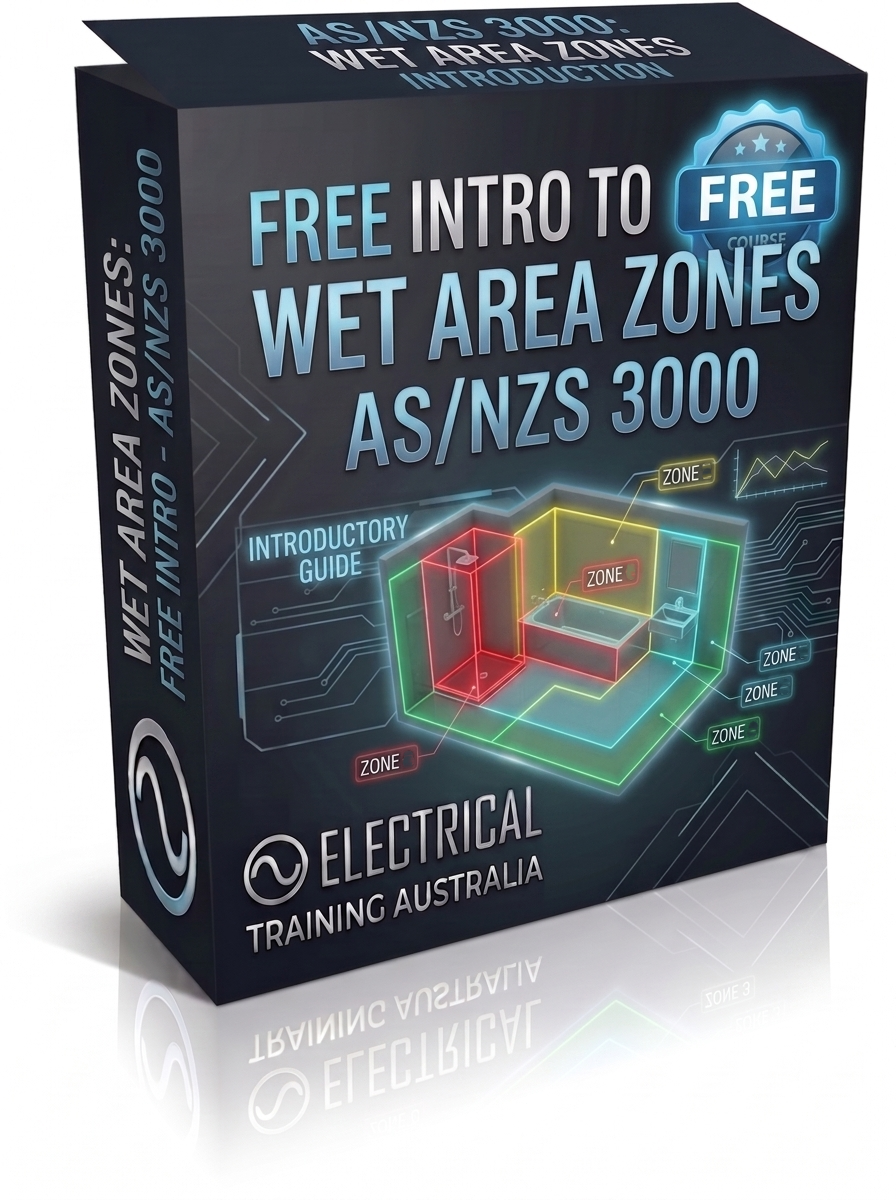
FREE Intro to Wet Area Zones
Baths and Showers FREE
Course Summary
This is Part 2 of the larger 10 Part course on Wet Area Zones
This course focuses on the safety requirements, environmental zones, and technical standards for electrical installations in wet areas around baths, showers, and medical water treatment facilities.
Module 1: Fundamental Classification & Barriers
Water Containers & Zones: Defining the environment for baths, showers, and fixed water containers.
The Role of Barriers (Clause 6.1): How glass screens, doors, and partitions limit zone dimensions.
New Inclusion: The classification of curtains as a recognized barrier to limit water spray zones.
Exceptions for Enclosures: Installing equipment behind IPX4-rated panels.
The "Tool Access" rule: When equipment is considered outside the zone due to restricted access.
Ceiling Recess Logic: Determining why recessed lighting and mechanisms behind ceiling surfaces are classified as outside the zone.
Module 2: Specialized Water Installations
Medical Treatment Facilities (AS/NZS 3003):
Requirements for oxidation baths, spa-style treatment tanks, and electronic patient-lowering machines.
Managing electrical supply for heated water systems in burn treatment and sensitive skin recovery.
Industrial Safety Facilities:
Chemical Safety Washdown: Treating deluge showers under Clause 6.2.2.1.
Eye Wash Stations: Treating self-contained units as fixed water containers (Clause 6.2.2.2).
Module 3: Mapping the Zones (Baths & Showers)
Zone 0: The Interior.
The water-holding area where installation is strictly limited.
Zone 1: The Spray Area.
Calculations for the 1.2m radius from the Fixed Plumbing Connection.
Vertical limits: 2.5m (Australia) vs. 2.25m (New Zealand).
Distinction between shower bases and tiled floors.
Zone 2: The Splash Area.
The 0.6m extension from the limit of Zone 1.
How zone dimensions shift when barriers (like 1.8m high screens) are introduced.
Zone 3: The Extended Area.
The 2.4m reach beyond Zone 2 and the inclusion of the area above Zone 2 (up to 2.5m).
Module 4: Technical Challenges & Site Scenarios
The "Fixed Plumbing Point" Rule: Why the zone is measured from the wall connection, not the end of a flexible hose.
Pendant Lights & Downlights: Safety risks of open fittings above baths.
Compliance for specialized fittings like IXL Tastics and LED-integrated shower roses.
Environmental Factors: The impact of unvented clothes dryers on moisture levels vs. IP ratings.
Extra-Low Voltage (ELV) applications in wet zones.
Learning Outcomes
Upon completion, participants will be able to: Identify the specific IP ratings required for enclosures within bathroom zones.
Calculate the reduction in zone dimensions provided by various barrier types.
Differentiate between standard domestic requirements and AS/NZS 3003 medical standards.
Audit lighting and power point placements to ensure they fall outside prohibited zones.
Course Curriculum

Alan Williams
Alan is an AS 3000 Subject Matter Expert and trains on AS 3000 and 17 related Electrical Standards.
He has contributed to 4 Standards Committees and has been a Director of the Institute of Electrical Inspectors for over 10 years and was the Chairman for 1 year. He provides expert leadership to electrical professionals across Australia.
Alan has 40 years of experience across many aspects of the electrical industry, including
- Heavy Industry (QAL & Gladstone Ports)
- High Voltage Switchyard Construction (Boyne Island)
- Maritime Ore Carrier Ships (Gladstone)
- Solar Farms & Renewables
- Transformer & Motor Manufacturing
- Domestic and Commercial installations
- and Aeronautics electrical maintenance.
As a professional trainer, Alan has run conferences, seminars, online training and onsite workplace training for thousands of electrical engineers, electricians, contractors and electrical workers.
Alan’s dynamic and engaging training, backed by his wide range of electrical experience as an electrician, contractor and Inspector, helps electrical workers across Australia and New Zealand understand and stay up to date with the AS3000 Wiring Rules, 17 related Electrical Standards and their associated changes.